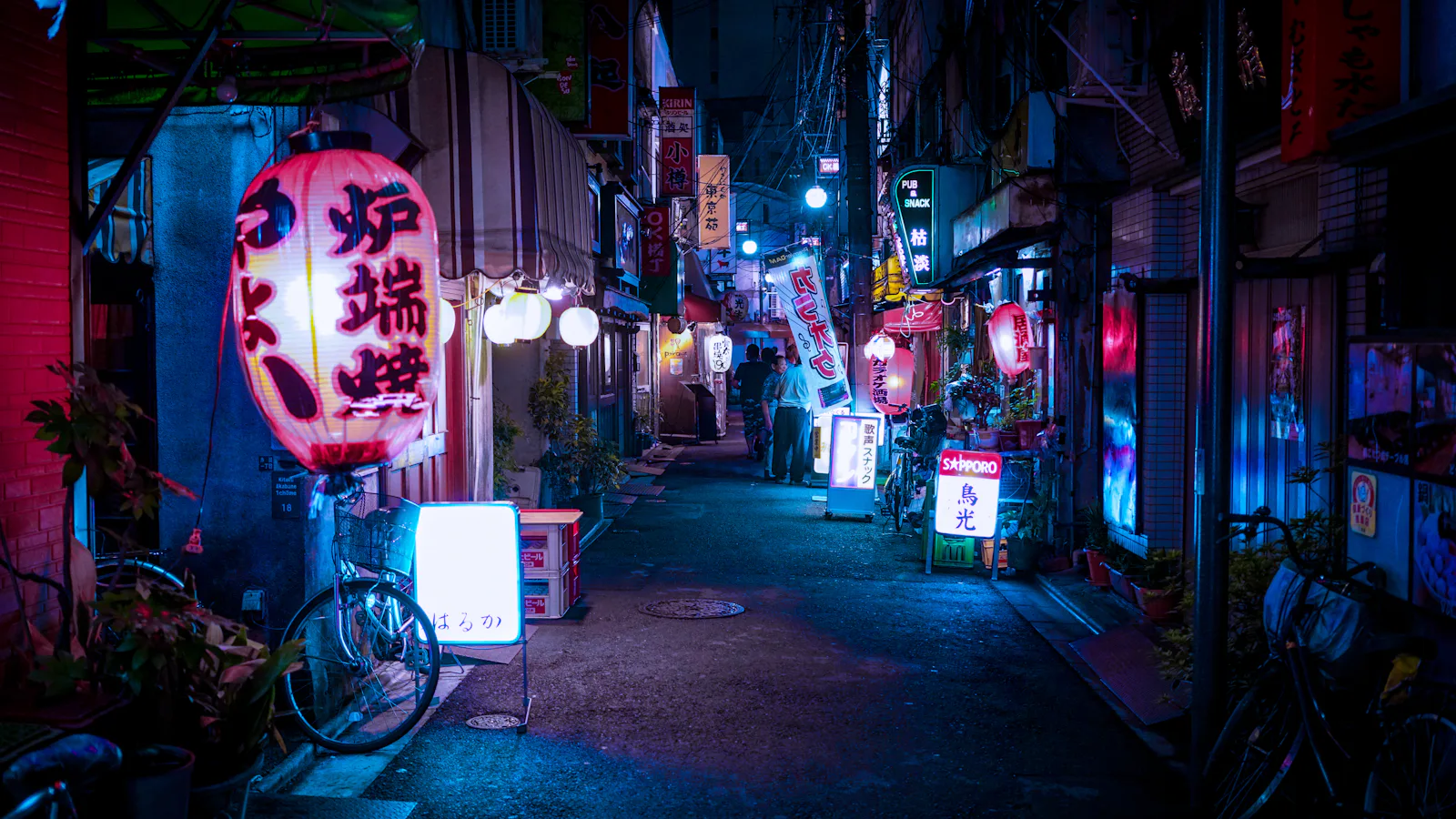
Six narrow alleys, more than 200 bars, most of them seating four to eight people. Golden Gai looks intimidating on purpose, and first-timers routinely walk the lanes twice, photograph a doorway and then retreat to a chain izakaya. That is a waste of one of the last places in Tokyo that still feels like the city did seventy years ago. The trick is not courage — it is knowing how to read a door.
What Golden Gai actually is
Golden Gai sits on the eastern edge of Kabukicho in Shinjuku, a block of low wooden buildings threaded by six pedestrian alleys and a few connecting passages. The structures are survivors: this was a grey-market drinking quarter in the years after the war, and when the rest of Shinjuku was demolished and rebuilt upward, this square somehow stayed low. Most buildings are two storeys, most bars are the size of a generous wardrobe, and the upstairs rooms are reached by staircases that would fail any building code written since.
Each bar is a personality rather than a business. One is jazz only, on vinyl. One belongs to a film crew. One is punk, one is manga, one has a ceiling covered in the business cards of regulars who have died. The owner — the mama or master — is the reason the place exists, and the six seats are effectively their living room.
How the cover charge works
Nearly every bar charges a seat fee on top of drinks. Expect roughly ¥500–1,500 per person, and treat it as rent on a stool in central Tokyo rather than a scam. Some bars include a small snack, the otōshi, in that figure.
The important part is that reputable bars post the charge on the door. A printed sign giving the cover, and often drink prices, is the single most reliable signal that the bar is happy to take a stranger. A bar with no posted price is not necessarily hostile, but you are agreeing to an unknown number, and that is where the horror stories come from. Carry cash: many of these bars have no card terminal and no interest in getting one.
How to read a door in ten seconds
- Green light: an English or photo menu taped up, the cover charge posted, lights on, door propped open, and a handwritten "welcome" or "tourists OK".
- Amber: no English but a posted price and an open door. Point, smile, hold up one finger. It usually works.
- Red: no sign at all, curtain drawn across the entrance, a "members only" notice, or a bar you can hear is entirely full. Keep walking — nobody is offended, and there are 199 others.
Upstairs bars are quieter and less touristed than ground-floor ones, and the staircase is the only barrier. If a sign at the bottom of the stairs lists a cover, that bar wants customers.
Etiquette inside
The rules are short, and following them is what turns a novelty stop into a good night.
- Order a drink promptly. Sitting without ordering reads as browsing.
- One drink is a complete visit. The local pattern is two or three bars in an evening, not four hours in one.
- Talk to whoever is beside you. In a six-seat room, sitting silently is the anti-social choice.
- Pay the cover without arguing. It was on the door.
- Do not bring in outside food or drink, and do not take a group of six into a bar that seats six.
- Keep your voice down in the alleys themselves. People live above some of these bars.
Photography is the one thing that reliably causes friction. Shooting the alleys is generally fine, but signs in several lanes ask you not to, and photographing inside a bar or of the staff without asking is not acceptable. Ask first; the answer is often yes.
Golden Gai or Omoide Yokocho?
They get confused constantly, and they are not substitutes for each other. Both are cramped post-war alley districts in Shinjuku, and that is where the similarity ends.
- Golden Gai is on the east side, past Kabukicho, and it is about drinking and conversation. Tiny bars, cover charges, owners with opinions, very little food. Come to talk to strangers.
- Omoide Yokocho is on the west side, right against the tracks by Shinjuku Station, and it is about eating. Yakitori, grilled offal, smoke, beer, counter stools, no cover charges. Come hungry.
The efficient plan is both, in that order: eat at Omoide Yokocho from about 19:00, walk twelve minutes east through the station area, and drink in Golden Gai from about 21:00. If you only have one night and want to meet people, choose Golden Gai. If you want dinner and atmosphere without social obligation, choose Omoide Yokocho.
When to go, and how to get there
Golden Gai is a night district in the strict sense — most bars open somewhere between 20:00 and 21:00, and many run until dawn. Arriving at 18:00 means walking through a shuttered film set. The sweet spot for a first visit is 21:00 to 23:00: bars are open and lit, but not yet full, so an owner has time to work out what you want. After the last trains go, around midnight to 01:00, the alleys fill with people who are committed to staying until the trains restart near 05:00 — atmospheric, but a harder room to walk into cold.
Getting there: Shinjuku Station east exit, or Shinjuku-sanchome on the Marunouchi, Fukutoshin and Shinjuku lines, which is closer. Walk toward Hanazono Shrine — the shrine backs directly onto the block, and it is the easiest landmark to navigate by. If you are still out when the trains stop, our guide to Tokyo's last train covers the options.
Frequently Asked Questions
Is Golden Gai foreigner-friendly?
Much of it is, and increasingly so. Bars that want international customers advertise it with English menus and a posted cover charge, and those are easy to spot from the alley. A minority remain effectively regulars-only, which they signal with a drawn curtain and no sign. Read the door rather than the guidebook.
How much does a night in Golden Gai cost?
Budget roughly ¥2,000–3,000 per bar: a cover charge of ¥500–1,500 plus a drink at ¥700–1,200. Two bars in an evening is a normal night out and lands around ¥5,000. Bring cash in ¥1,000 notes — card acceptance is patchy at best.
What time does Golden Gai open?
Most bars open between 20:00 and 21:00 and many stay open until around 05:00. There is no single schedule, and individual owners close whenever they feel like it. Before 20:00 the alleys are largely shut.
Can you take photos in Golden Gai?
Photographing the alleys is usually tolerated, but several lanes post signs asking visitors not to, and those should be respected. Never photograph inside a bar, or the staff, without asking first. Tripods and flash in the alleys are a fast way to be asked to leave.
What is the difference between Golden Gai and Omoide Yokocho?
Golden Gai, east of Shinjuku Station, is a district of about 200 tiny bars built for drinking and conversation, and most charge a seat fee. Omoide Yokocho, on the west side by the tracks, is a food alley of yakitori and grill counters with no cover charges. Drinking versus eating, essentially — and they are close enough to do both in one night.
Do you need to book a bar in Golden Gai?
No, and mostly you cannot. These are walk-in rooms with four to eight seats, so availability is a matter of luck and timing. If a bar is full, walk to the next one; on a busy Saturday you may try three doors before you sit down.