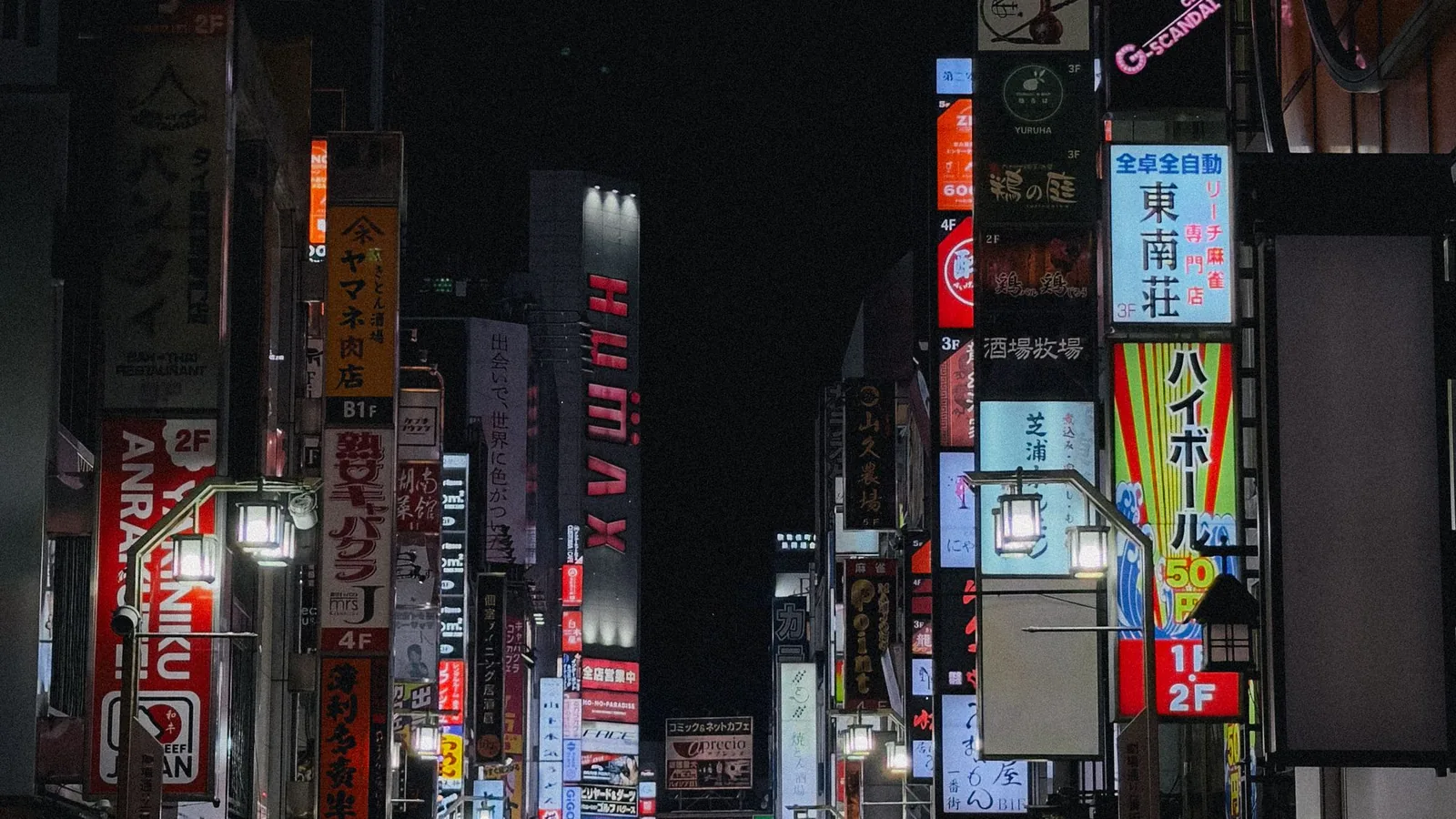
Shinjuku doesn't wind down after the last train — it just changes gear. Within a few minutes' walk you can cross from the neon crush of Kabukicho to a three-seat bar in Golden Gai to a smoky yakitori counter in Omoide Yokocho, each with its own rhythm and rules. Here's how the district's after-dark zones fit together, and where to go deeper on each. If the night runs long, keep our last train guide to hand.
The short version: four districts, all within fifteen minutes on foot, all reached from the station's east side apart from the yakitori lane on the west. Carry ¥10,000 in cash, expect a per-person seat charge wherever you sit down, and never follow anyone who stops you in the street.
Start by solving the station. Shinjuku moves more people than any other rail station on earth and has well over a hundred exits, which means "meet me at Shinjuku" is not a plan and the wrong exit can put you a ten-minute walk from where you meant to be.
Learn two of them and the evening organises itself. The East Exit puts you at the foot of Kabukicho and within a few minutes of everything east of the tracks; the West Exit drops you beside the yakitori lane. Everything in this guide hangs off those two.
The district also runs to a schedule. Restaurants fill from seven, the small bars come alive around ten, and the streets are at their busiest between eleven and the last train — arrive at nine and you will get a seat anywhere, arrive at midnight and you are competing for the last stools in the district.
Kabukicho: the neon core
Japan's biggest entertainment quarter sprawls north of the station's east side — a grid of towering signs, host and hostess clubs, izakayas and karaoke. It's safer than its reputation, but it runs on commission: the young men in suits working the street are touts, not welcomers. The one rule that keeps your night cheap is simple — don't engage, and only step into places that post their prices outside. A host club can bill ¥20,000+ for a couple of hours; a beer in a normal izakaya a street away is about ¥500.
The full breakdown is in our guide to Kabukicho at night.
Golden Gai: micro-bars
A few minutes east, Golden Gai is the opposite of Kabukicho: six tight lanes of around two hundred tiny bars, many seating just three to six people. Each has a theme — punk, jazz, film, a particular whisky shelf — and its own owner. Some welcome first-timers with English menus; others are members' locals where a small table charge (¥500–1,000) applies. There are no touts here: you find the door, and you're invited in.
How to pick a bar and not fumble the etiquette: Golden Gai for first-timers.
Omoide Yokocho: smoke and skewers
By the tracks on the west side, "Memory Lane" — its old nickname is Piss Alley — is a cramped lane of yakitori stalls thick with charcoal smoke. Counters seat a handful, it's cash only, and skewers run ¥150–300 with a draft beer around ¥500. It fills up fast after 7pm with office workers; come early for a stool or be ready to stand.
More on it in Omoide Yokocho — and if you're still hungry later, there's 4am ramen in Shinjuku.
Ni-chome: the fourth district
Ten minutes east of the station sits Shinjuku Ni-chome, the densest concentration of gay bars anywhere in the world — a few blocks holding several hundred of them, most no larger than the Golden Gai boxes.
It is a working neighbourhood rather than a sight, and it runs on the same economics as the rest of Shinjuku: tiny rooms, a seat charge, an owner behind the counter who sets the tone. Plenty of bars are mixed and welcome anyone; some are explicitly for their own regulars, and the sign on the door usually says which.
Weekends after eleven are when the streets fill and the crowd spills outside. Come earlier and it is quiet enough to talk, which is rather the point of the place.
Touts, bottakuri and how the rip-off actually works
Touting on the streets of Shinjuku is illegal, and it happens on every corner of Kabukicho regardless. The city plays recorded warnings in English through street speakers telling you not to follow anyone — which tells you how well the ban is working.
The scam has a name: bottakuri, roughly "rip-off". A friendly man offers cheap drinks and a short walk, the bar has no prices on display, and the bill at the end runs from several hundred dollars to genuinely ruinous sums, backed by staff who make leaving difficult.
The defence is simple and absolute. Never follow anyone who approaches you on the street, however good their English and however reasonable the offer sounds. Bars worth drinking in do not need to recruit outside.
Everything else follows from that one rule: walk into places you chose yourself, check that prices are posted before you sit, and treat an unpriced menu as the exit sign it is. Kabukicho is otherwise a safe place to walk around at night, and the danger here is to your wallet rather than to you.
After-dark basics
- Carry cash. Most small bars and stalls are yen-only; ¥10,000 covers a comfortable night.
- Ignore the touts in Kabukicho, and skip any place that won't show prices or names a vague "cover charge".
- Watch the clock. Trains stop around midnight–1am; miss them and a taxi across town is ¥3,000+. See the last train guide.
- Dress is casual everywhere here — just look tidy for the smaller Golden Gai bars.
The seat charge deserves its own paragraph, because it is the fee people mistake for a scam. Otoshi is a per-person charge that arrives with a small dish you did not order: roughly ¥300–700 at a casual izakaya, ¥500–1,000 in Golden Gai.
It is legitimate, it is charged to everyone including locals, and it is not a tourist markup. What separates it from an actual rip-off is scale and disclosure — a stated few hundred yen with a snack is otoshi; an unexplained ¥20,000 "service charge" is not.
Budget in blocks rather than per drink. Two bars in Golden Gai with seat charges runs ¥4,000–6,000 a head; dinner in Omoide Yokocho and a couple of beers, half that; a night that ends with a taxi rather than a train, add ¥3,000 on top.
Group size shapes the evening more than budget does. Two or three people can walk into almost anywhere; four or more will find Golden Gai physically impossible in most bars and should plan on an izakaya first, splitting up afterwards.
All four districts sit east of the station except Omoide Yokocho, which is on the west side by the tracks — so use the East Exit as the default and cross under once for the yakitori.
The trick to Shinjuku after dark isn't finding somewhere to drink — it's picking the right lane. Treat Kabukicho as spectacle, Golden Gai as conversation, Omoide Yokocho as dinner and Ni-chome as the place you end up talking until the trains start, and the district stops being overwhelming and starts to make sense.