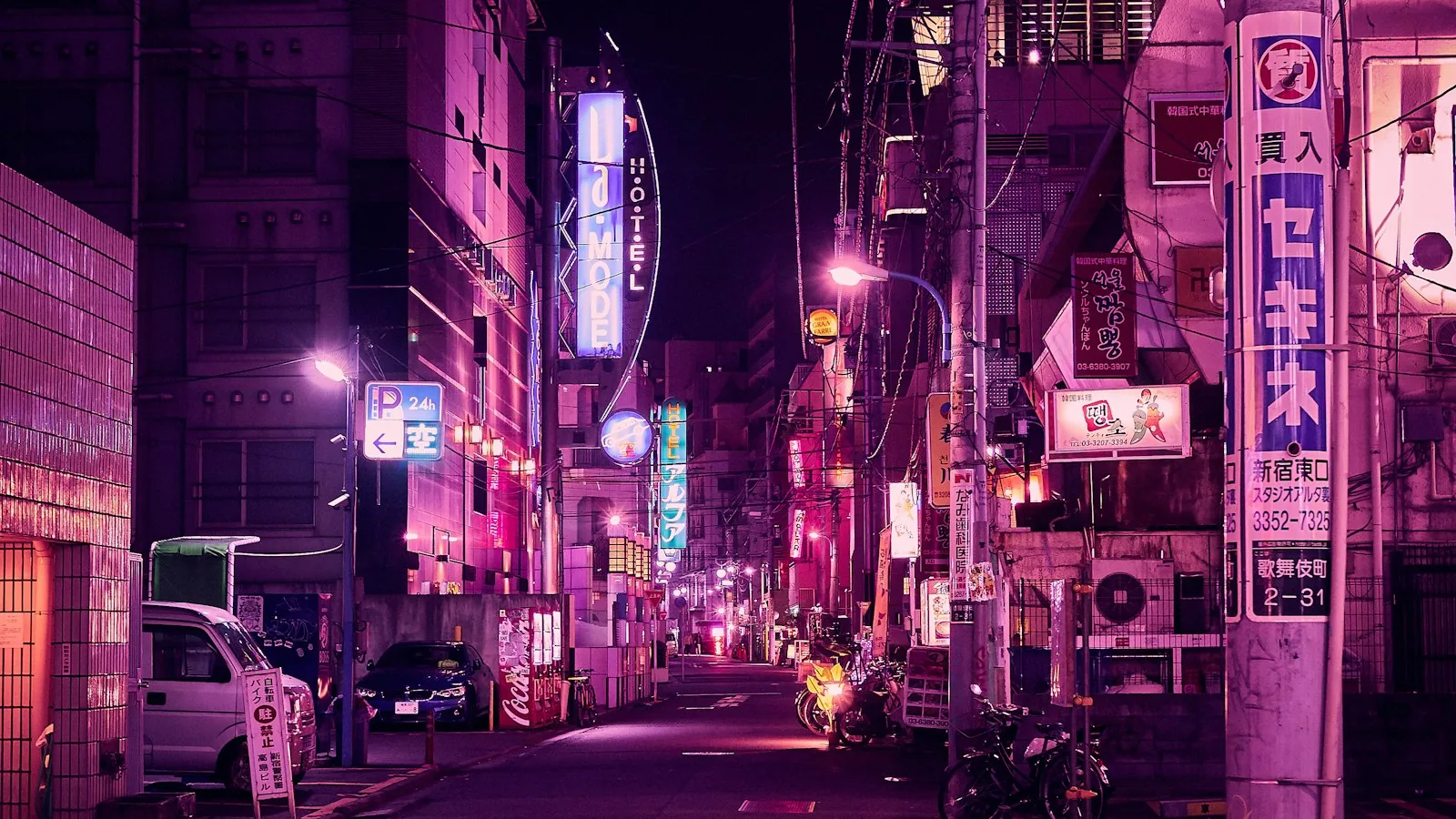
Tokyo's trains stop around midnight to 1am and don't start again until about 5am — but in Shinjuku, missing the last one isn't a crisis so much as a menu of warm places to wait it out. Here are your options, cheapest instinct first. For how the last-train timing actually works, see our last train guide.
The short answer: a net cafe booth runs about ¥1,500–3,000 for the night, a capsule pod ¥3,000–6,000 for a walk-in, and a taxi across central Tokyo ¥2,500–3,000 with the 20% late-night surcharge applied. Waiting for the first train, somewhere between 4:30 and 5am, costs the price of a coffee.
What each option actually costs
The five realistic choices sort themselves by price rather than comfort, and the cheap end is not the miserable end. Ranges move with season and district — these are what you will see quoted around Shinjuku on a normal weeknight.
- Wait it out in a konbini or on a bench — the price of coffee. Fine for an hour, grim for four.
- Net or manga cafe — ¥1,500–3,000 for a night pack running roughly 23:00 to 05:00, soft drinks included. The best value on the list.
- Sento or super-sento — a neighbourhood bath is a few hundred yen; the large spa complexes with reclining lounges cost several times that, and add a surcharge if you stay past midnight.
- Capsule hotel — ¥3,000–6,000 walking in late, less if you book earlier in the evening from your phone.
- Taxi home — ¥2,500–3,000 for a short central hop such as Shibuya to Shinjuku, more the further you go. See below on the surcharge.
A love hotel is the sixth option nobody lists, and for two people it is often the cheapest room of the lot. Rates split into a short "rest" block and an overnight "stay" block, with the overnight rate usually starting somewhere around midnight — which happens to be exactly when you need it.
Sleep in a capsule
The reliable move is a capsule hotel: a locker, a bath, and a clean sleeping pod for far less than a hotel room, and they take walk-ins deep into the night. They're built for exactly this — solo, tired and unplanned.
Expect ¥3,000–6,000 for a late walk-in around Shinjuku, at the higher end on Friday and Saturday. Booking from your phone while you are still in the bar often saves a thousand yen over turning up at the desk at one in the morning.
Most floors are single-sex. Plenty of the older places are men-only, though the larger chains keep a women's floor and a separate lift to reach it — worth checking on the booking page rather than at reception.
What you get is a pod with a screen or blind rather than a door, a shared bath, and a locker for your bag. What you do not get is silence: earplugs are usually free at the desk, and taking a pair is the difference between three hours of sleep and none. Bring a little cash for the front desk.
Soak and doze at a sento or spa
Cheaper still, and the classic Tokyo trick: a late-night sento or a big spa complex (super-sento). Wash thoroughly at the showers first, then soak, sauna and cold-plunge — and many have reclining-chair lounges where you can doze until the trains restart.
The neighbourhood sento is the bargain, priced as a public utility rather than an attraction. The trade-off is that most close well before the trains do, so they solve a late evening rather than a whole night.
Super-sento are the ones that stay open through to morning. They cost several times a plain bath, add an overnight surcharge once you cross midnight, and in exchange give you a lounge, blankets, food and somewhere to charge a phone.
One thing to check before you commit: a fair number of bathhouses still refuse entry to visible tattoos, and the policy is usually posted in English at the door. Facilities aimed at travellers are increasingly relaxed about it, but the rule is applied by the individual house, not by the city. LIVE JAPAN keeps a running list of the places that take walk-ins through the night.
Stay up instead
- Konbini — 7-Eleven, Lawson and FamilyMart are everywhere and open 24/7, with genuinely good hot food, coffee and a bench nearby.
- Manga / net cafes — a private booth with a reclining seat, a drinks bar, often a shower, and a "night pack" rate that runs till morning. Tokyo's quiet fallback for the trainless.
- Karaoke — 24-hour rooms with free-time packages and full food menus; sing, eat and nod off in your own room. Still hungry? There's 4am ramen in Shinjuku.
The net cafe deserves its reputation. A night pack buys a lockable-ish booth, a reclining chair or a flat mat, unlimited soft drinks, usually a shower for a small extra fee, and enough quiet to sleep badly but genuinely sleep.
You will need your passport to register as a first-time member, and the sign-up takes a few minutes at the counter. Do it before you are too tired to spell your own name.
Karaoke works out slightly dearer than a net cafe but comes with a door that closes and a sofa long enough to lie on. For two or three people splitting a room it is the most comfortable cheap option in the district, and nobody minds if the singing stops at two.
Getting home instead: taxis and the surcharge
Tokyo taxis add a late-night surcharge of 20% between 10pm and 5am, applied automatically to the meter. It is not negotiable and not a scam, whatever the fare looks like at the end.
A short central hop — Shibuya to Shinjuku, about four kilometres — lands around ¥2,500–3,000 once the surcharge is on. Crossing town, or heading out to the suburbs where many people actually sleep, climbs steeply from there.
Split three or four ways, a taxi stops being the extravagant choice and starts beating two capsule beds. That maths is why the ranks outside Shinjuku station look the way they do at half past midnight.
Coming in from the airport rather than heading home? That is a different problem with its own timetable — see getting from the airport to Tokyo at night.
Or simply wait for 5am
If it's a mild night and there's only an hour or two to go, the first trains come early. Depending on the line, the first departures roll between about 4:30 and 5am, and the platform gates open a little before that.
The gap is shorter than it sounds. Miss the last train at 00:40 and you are looking at under four hours, most of which can be spent eating, bathing or sitting somewhere warm rather than staring at a departure board.
A koban — the small police box near most stations — will point you to the right platform or the nearest open konbini, and the officers are used to the question. Keep your phone charged; the walk back at 4am is easier with a map and a train app that knows which gate opens first.
And if you've still got energy, the district doesn't sleep — see our Shinjuku nightlife guide, or work out what all of this does to a daily budget in Tokyo after dark on a budget. Japan Experience has a useful primer on the same situation outside Shinjuku.
Miss the train on purpose once in a while: Shinjuku after midnight, with the crowds gone, is one of the better versions of the city.